By : Asma Ahmed
Overcoming Complex Fractures with Virtual Mirroring and Custom Design
Managing complex orbital wall fractures is a significant challenge due to the intricate anatomy of the eye socket. Modern advancements in CAD/CAM and 3D printing now allow for the creation of PEEK Patient-Specific Implants (PSIs) that restore orbital volume with high translational accuracy
Return to traditional ?
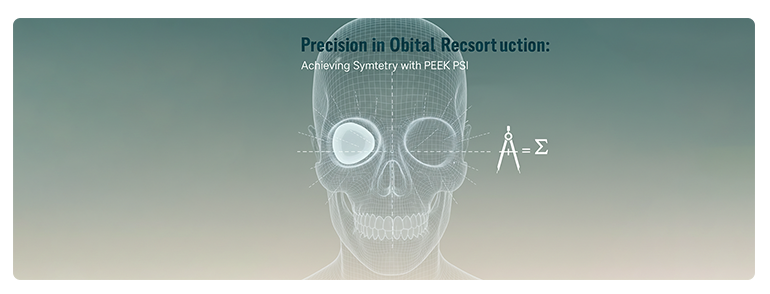
A key component of this process is the "mirroring" technique, where the healthy side of the patient’s face is used as a template to design an ideal prosthesis for the injured side.
Clinical
Clinical studies confirm that PEEK PSIs provide a "one-fit" characteristic that ensures satisfactory results even in the absence of intraoperative navigation systems, significantly enhancing surgeon confidence and patient outcomes